
Creating Users
Creating Users
As a Builder Admin, you can create and manage users in your Builder Org through the Zus App or the Zus Auth Service API.
A user on Zus is a human with a name, email address, and credentials that verify their identity. Users sign in to access Zus APIs and UIs. (To create non-human accounts, see App Clients.)
Which method should I use?
- Use the Zus App for one-off user management — adding teammates, editing details, etc.
- Use the API when you need to automate user provisioning, integrate with your own onboarding flow, or link users to FHIR Practitioner resources at creation.
Creating users in the Zus App
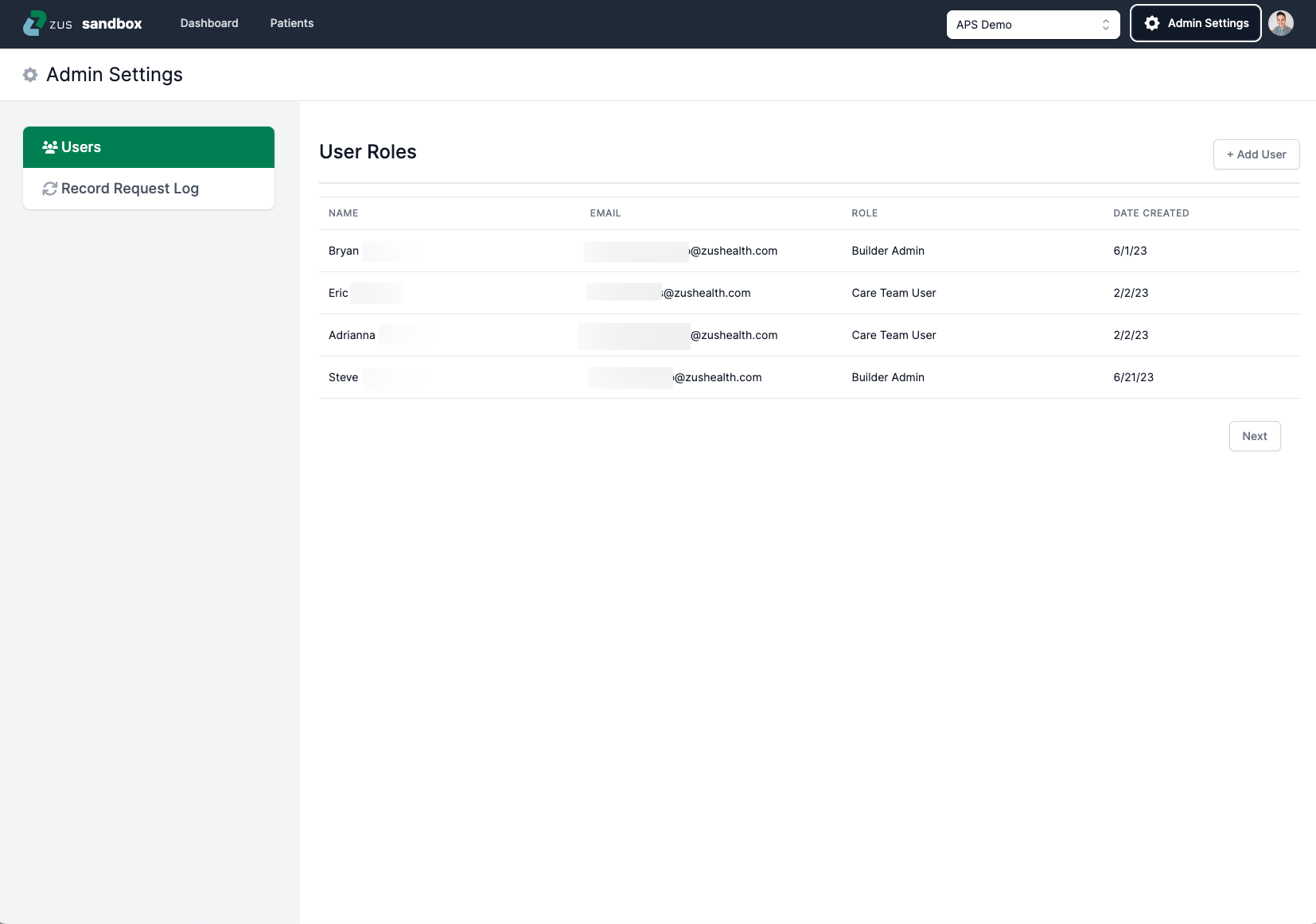
In the Zus App, go to Admin Settings → Users to view, add, edit, or delete users.
Creating users via API
Creating a user via the API takes two main steps (plus one optional step for clinical users):
- (Optional) Create a FHIR Practitioner resource — for clinical users only.
- Look up the role ID you want to assign.
- Create the user with that role (and optionally link the Practitioner).
For a runnable walkthrough, see the User Creation Guide in the Zus Health Postman Collection.
Step 1 (Optional): Create a FHIR Practitioner resource
Skip this step unless you're creating a clinical user.
For clinical users, you can create a FHIR Practitioner resource and link it to the user's identity. Once linked, the Practitioner can be assigned to FHIR Care Teams and PractitionerRoles.
A minimal Practitioner — just first and last name — is enough. Save the practitioner_id returned by this call; you'll use it in Step 3.
Request
POST https://api.sandbox.zusapi.com/fhir/Practitioner{
"resourceType": "Practitioner",
"active": true,
"name": [
{
"family": "{{FamilyName}}",
"given": ["{{GivenName}}"]
}
]
}Step 2: Look up the role ID
Each user is assigned exactly one role. The available roles are:
| Role | Use for |
|---|---|
Builder Admin | Teammates who need to manage your Builder Org (create users, configure settings, etc.). |
Care Team User | Clinical or operational users who need to access patient data through Zus. |
Set the RoleName variable to either Builder Admin or Care Team User, then make this request to fetch its ID:
Request
GET https://api.sandbox.zusapi.com/auth/roles?filter[name]={{RoleName}}Response (abbreviated)
{
  "data": [
    {
      "type": "auth/roles",
      "id": "<UUID>",
      "attributes": {
        "name": "Care Team User",
        "description": "",
        "isManaged": true,
        "permissions": ["..."],
        "createdAt": 1638828368,
        "updatedAt": 1655996421
      }
    }
  ]
}
Copy the id value — you'll pass it as RoleID in Step 3.
Step 3: Create the user
This call creates the user account, assigns the role from Step 2, and optionally links the Practitioner from Step 1.
Request
POST https://api.sandbox.zusapi.com/auth/users{
"data": {
"type": "auth/users",
"attributes": {
"email": "{{Email}}",
"name": "{USERNAME}",
"userType": "builder",
"clientId": "PuzaR6b4U1l2wMC3qciU1qUJI2fOxJLw",
"sendPasswordResetEmail": true
},
"relationships": {
"auth/roles": {
"data": {
"type": "auth/roles",
"id": "{{RoleID}}"
}
},
"fhir/practitioner": {
"data": {
"type": "fhir/practitioner",
"id": "{{OptionalPractitionerID}}"
}
}
}
}
}Field reference
| Field | Required? | Description |
|---|---|---|
email | Required | The user's email address. If you later set up SSO, this must match the email at their identity provider. |
name | Required | The user's display name. |
userType | Required | Set to "builder". |
clientId | Optional | Redirect target after password reset. The value shown above sends users to the Zus documentation site. |
sendPasswordResetEmail | Optional | Whether to email the user a password-reset link. Defaults to true. Set to false to suppress. |
auth/roles.data.id | Required | The RoleID from Step 2. |
fhir/practitioner.data.id | Optional | The practitioner_id from Step 1. Omit this relationship block entirely if you skipped Step 1. |
What happens after the user is created
- Sandbox environment: New users receive a welcome email with links to Zus apps and documentation.
- Production environment: No welcome email is sent.
- If
sendPasswordResetEmailistrue(the default), the user also gets a password-reset email so they can set their initial password.
Updated 4 days ago