
Data Sharing
What patient data Zus shares with other organizations on Zus and with EHR networks, and what it holds back.
Designated Record Set
Zus has defined a minimum set of resource types for patients as a “Designated Record Set” that your users and app clients can access from other Builders on Zus that have relationships with your patients, without explicit patient consent. This Designated Record Set aligns with the requirements of the 21st Century Cures Act, ONC Information Blocking rules, and HIPAA. See below for the full list of resource types included in the Designated Record Set.
Resource Types in the Designated Record Set:
| Column 1 | Column 2 | Column 3 |
|---|---|---|
| Account | DeviceRequest | MedicationStatement |
| AllergyIntolerance | DiagnosticReport | MolecularSequence |
| Appointment | DocumentManifest | NutritionOrder |
| AppointmentResponse | DocumentReference | Observation |
| BodyStructure | Encounter | Patient |
| CarePlan | EpisodeOfCare | Person |
| Care Team | FamilyMemberHistory | Procedure |
| ClinicalImpression | Flag | Provenance |
| Composition | Goal | RelatedPerson |
| Condition | ImagingStudy | RiskAssessment |
| Consent | Immunization | ServiceRequest |
| Coverage | ImmunizationEvaluation | Specimen |
| CoverageEligibilityRequest | ImmunizationRecommendation | SupplyDelivery |
| CoverageEligibilityResponse | MedicationAdministration | SupplyRequest |
| DetectedIssue | MedicationDispense | VisionPrescription |
| Device | MedicationRequest |
ℹ️ Today, Zus shares binaries as part of the Designated Record Set to support access to content such as CCDAs and raw ADT messages. If you intend to write binaries to Zus and would like to withhold them from the DRS, please reach out to your Customer Success contact.
Zus doesn't detect sensitive content inside documents such as PDFs, CCDAs, notes or images. Because binaries are shared in the DRS, you must label sensitive documents
Restrictedor withhold them from Zus. See Specially Regulated Data.
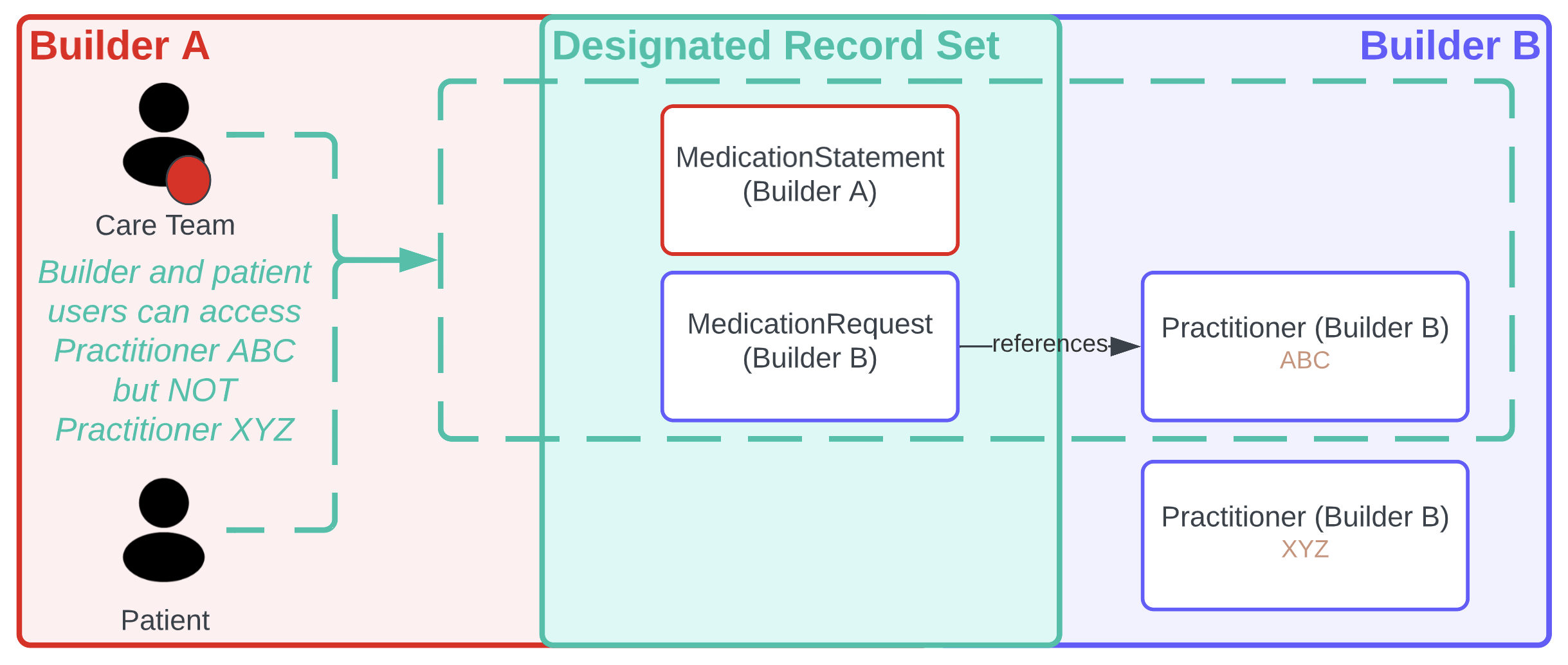
Zus also provides access to a small set of foundational resources (see below) owned by other Builders if they are referenced by Designated Record Set resources. For example, a care team user viewing a patient’s ZAP may want to know who ordered a MedicationRequest from another Builder. The MedicationRequest resource contains a reference to a Practitioner resource in the other Builder. Thus, the care team user can see the Practitioner referenced by the MedicationRequest.
Foundational Resources Referenced by Designated Record Set Resources:
- Location
- Medication
- Organization
- Practitioner
- PractitionerRole
- Provenance
Inactive Patients Included in the ZAPOther Builders on Zus can view Designated Record Set data for your inactive patients via the ZAP if these Builders have a relationship with the patients.
Responses to EHR Networks
Today, when Zus receives an inbound data request from CommonWell or Carequality for a patient, we respond with a Continuity of Care Document (CCD) that incorporates the following resource types:
- AllergyIntolerance
- Appointment
- CarePlan
- CareTeam
- Condition
- Consent
- Coverage
- DeviceUseStatement
- DiagnosticReport
- DocumentReference
- For DocumentReferences associated with an encounter:
a. These are incorporated into the Encounters section of the CCD.
b. DocumentReference.context must contain a reference to an Encounter resource. - For DocumentReferences not associated with an encounter:
a. These are incorporated into a Notes section of the CCD. - When syncing clinical notes to Zus, please ensure they meet the following requirements:
a. As narrative text in DocumentReference.text
b. As Base64-encoded text in DocumentReference.content.attachment.data
c. Both formats are supported and will be incorporated if present.
- For DocumentReferences associated with an encounter:
- Encounter
- FamilyMemberHistory
- Immunization
- MedicationAdministration
- MedicationDispense
- MedicationRequest
- MedicationStatement
- Observation
- Patient
- Procedure
- QuestionnaireResponse
- Incorporated into the Social History section of the CCD as a table of each question, its response, and the response date.
- These are included as Social History observations, not as structured assessment scale observations.
Related pages
Updated 8 days ago