
Common Patient Record within Zus
How Zus shares a patient's record between organizations on Zus, what's included, and what's held back.
Zus maintains a single Common Patient Record (CPR) for each patient. It brings together the data Builders write to Zus and the records Zus retrieves from networks such as CommonWell, Carequality and TEFCA. Your users and app clients see a patient's CPR through the Zus Aggregated Profile (ZAP).
Who can access a patient's record
An organization on Zus can access a patient's shared data when both of these are true:
- It has a relationship with the patient. The organization asserts a treatment, payment or operations (TPO) relationship by setting
Patient.activetotrue. Enrolling or querying a patient sets this automatically. See Network Requirements. - It can match the patient. The organization provides enough demographic information to match the patient in the Universal Patient Index.
The resource types in the CPR, the Designated Record Set, align with the 21st Century Cures Act, ONC Information Blocking rules and HIPAA.
Other Builders can still see shared data for patients you've marked inactive, as long as they have their own relationship with the patient.
What's shared
Resource types in the Designated Record Set:
| Column 1 | Column 2 | Column 3 |
|---|---|---|
| Account | DeviceRequest | MedicationStatement |
| AllergyIntolerance | DiagnosticReport | MolecularSequence |
| Appointment | DocumentManifest | NutritionOrder |
| AppointmentResponse | DocumentReference | Observation |
| BodyStructure | Encounter | Patient |
| CarePlan | EpisodeOfCare | Person |
| Care Team | FamilyMemberHistory | Procedure |
| ClinicalImpression | Flag | Provenance |
| Composition | Goal | RelatedPerson |
| Condition | ImagingStudy | RiskAssessment |
| Consent | Immunization | ServiceRequest |
| Coverage | ImmunizationEvaluation | Specimen |
| CoverageEligibilityRequest | ImmunizationRecommendation | SupplyDelivery |
| CoverageEligibilityResponse | MedicationAdministration | SupplyRequest |
| DetectedIssue | MedicationDispense | VisionPrescription |
| Device | MedicationRequest |
Referenced foundational resources. Zus also shares a small set of foundational resources owned by other Builders when a shared resource references them:
- Location
- Medication
- Organization
- Practitioner
- PractitionerRole
- Provenance
For example, a care team user may want to know who ordered a MedicationRequest written by another Builder. The MedicationRequest references a Practitioner in that Builder, so the user can see that Practitioner.
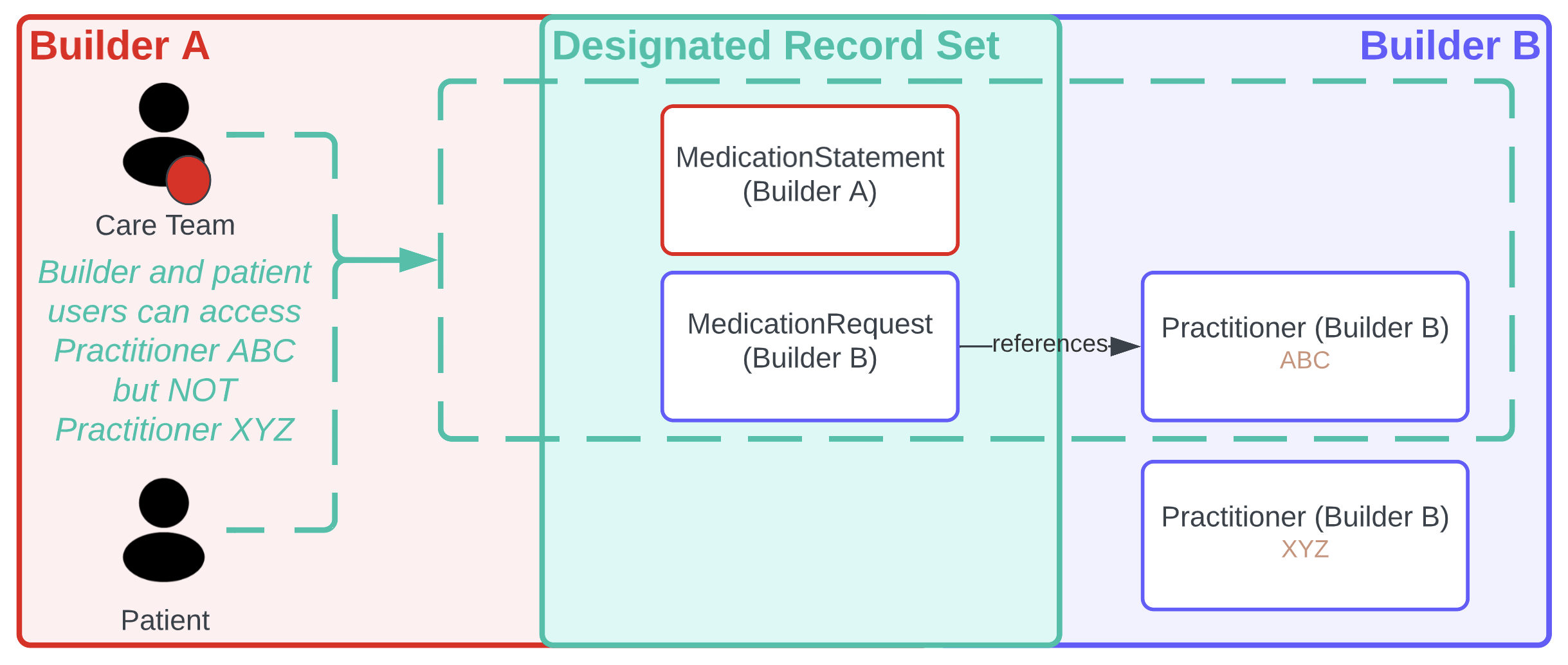
Binaries. Zus shares binaries so users can open content such as CCDAs and raw ADT messages. If you plan to write binaries to Zus and want to withhold them, contact your Customer Success contact.
Network data is part of the record
When any Builder retrieves records for a patient from the networks, those records become part of that patient's CPR. Your organization may see network data for a patient even if it never ran a query for that patient itself.
What's held back
- Restricted data. Resources with a
Restrictedconfidentiality label are visible only to the Builder that owns them and to Builders it has granted cross-builder access. See Specially Regulated Data. - Patients who opt out. Zus stops sharing and retrieving data for patients who opt out. See Patient Opt Out.
Zus doesn't detect sensitive content inside documents such as PDFs, CCDAs, notes or images. Because binaries are shared, you must label sensitive documents
Restrictedor withhold them from Zus. See Specially Regulated Data.
Related pages
Updated 14 minutes ago