
Patient Monitoring & Chart Builds
Enroll patients in a Zus monitoring subscription to keep the ZAP current, or run one-time queries of the networks.
For patients you care for over time, enroll them in Monitoring. Zus builds their available medical history in the Zus Aggregated Profile (ZAP), then uses Intelligent Refresh to look for new records as care happens and ahead of appointments.
Monitoring is the primary way to keep a patient's ZAP current. For a point-in-time need, such as a one-time intake review, use a Chart Build to retrieve available history without ongoing Monitoring.
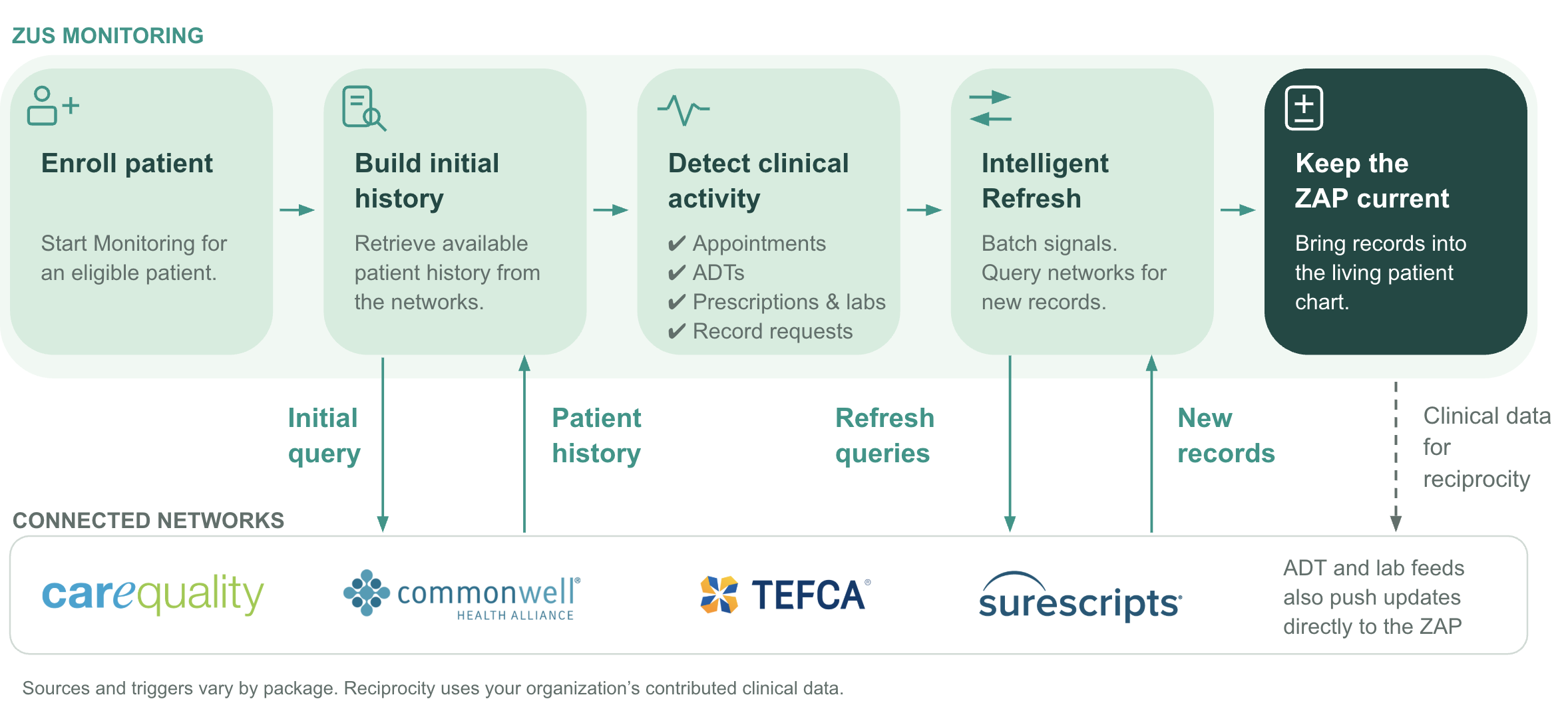
Enroll once, keep the chart current
Enrollment starts an ongoing process:
- Build the history. Zus retrieves available patient records from the networks included in the patient's Monitoring package.
- Watch for clinical activity. Zus uses signals such as upcoming appointments and evidence of care at other organizations to identify when new information may be available.
- Refresh the ZAP. Intelligent Refresh queries relevant networks and organizations. Enabled notification feeds also deliver updates directly to Zus.
Your Monitoring package determines the data sources, historical lookback, and refresh triggers available for each patient. Work with your Zus team to configure coverage for your care model.
How data reaches the ZAP
Monitoring combines queries for new records with updates delivered by connected sources. These mechanisms work together; receiving a notification and retrieving the documentation for that event are separate steps.
| Data source | How the ZAP is updated when the source is enabled |
|---|---|
| EHR networks | Zus retrieves available history, then uses Intelligent Refresh to query for new clinical records based on relevant signals. |
| Pharmacy network | Zus retrieves medication history and uses event-based refreshes to look for new medication data. Additional refreshes around expected refills require medication adherence functionality. |
| Admission, discharge, and transfer (ADT) feeds | Notifications are pushed to Zus as covered events are reported. They can also trigger queries for related clinical documentation. |
| Lab network | Zus retrieves available historical results at enrollment; new results are pushed to Zus. Lab activity can also signal that other clinical records may be available. |
Not every source or trigger is included in every package. History and updates depend on patient matching, network coverage, and the records available from responding organizations.
Enroll your patients
Provide sufficient patient demographics and treating-provider information for network queries, and maintain an active treatment relationship. See Network Requirements for the requirements that apply to your organization.
Enroll via API
Use the zap-data-subscriptions API, also available in the Zus Postman collection, to manage enrollment:
- List available packages.
- Enroll a patient.
- View current enrollments.
- Update enrollment details.
- Unenroll a patient.
A patient can be enrolled in one package at a time. Attempting to create a duplicate enrollment returns an error. To change packages, unenroll the patient from the current package and enroll them in the new package.
Enroll through an EHR integration
Supported EHR integrations can automatically enroll patients based on your configured workflow. See Automatic Patient Enrollment via EHR Integrations.
Enroll via flat file
For batch enrollment, use Enrollment via Flat File to create or update patients and manage enrollment through CSV uploads.
Help Zus refresh at the right time
Keep eligible patients actively enrolled and write appointments to Zus as early as possible. Appointment data lets Zus prepare the ZAP before your team sees the patient. Keep appointment dates and cancellations current so refreshes follow the care you plan to deliver.
See Intelligent Refresh for how signals lead to queries and what to expect from data freshness.
When to use a Chart Build
A Chart Build retrieves available patient history for a specific point-in-time need. It does not enroll the patient in Monitoring or start ongoing Intelligent Refresh. Use Monitoring when your team needs an evolving record across visits and between encounters; use a Chart Build when you need history for a discrete clinical interaction.
See Chart Builds for requesting a build, choosing a configured build type, and checking job status.
How Zus targets queries
For both Monitoring and Chart Builds, Zus optimizes network queries for the patient's package and use case. Queries may use a limited lookback, focus on organizations most likely to have relevant data, or cap documents retrieved from a single responding organization.
These controls reduce repeated requests and duplicate documents. A refreshed ZAP reflects the data available through connected sources; it is not a guarantee that every record or encounter is present.
Updated 9 days ago